
The Argument on the Page, Then in the Catalogue
Neville Brody became art director of The Face in 1981, when the London music and style magazine was barely a year old. Over five years he turned its pages into a laboratory: custom letterforms replaced conventional typefaces, headlines were treated as graphic objects, and the hierarchy between image and text collapsed deliberately. By the time he left in 1986, The Face had produced a visual language that influenced editorial design well beyond Britain. His subsequent work on Arena, launched in 1986, extended the same method into men's publishing, with tighter grids and a slightly more austere palette.
What made Brody's approach legible to the wider design world was a 1988 retrospective exhibition at the Victoria and Albert Museum and the accompanying monograph — one of the fastest-selling design books of its decade. The book documented not only layouts but the custom typefaces Brody had built for editorial use: faces that had never been commercially released, drawn to serve a specific argument on a specific page.
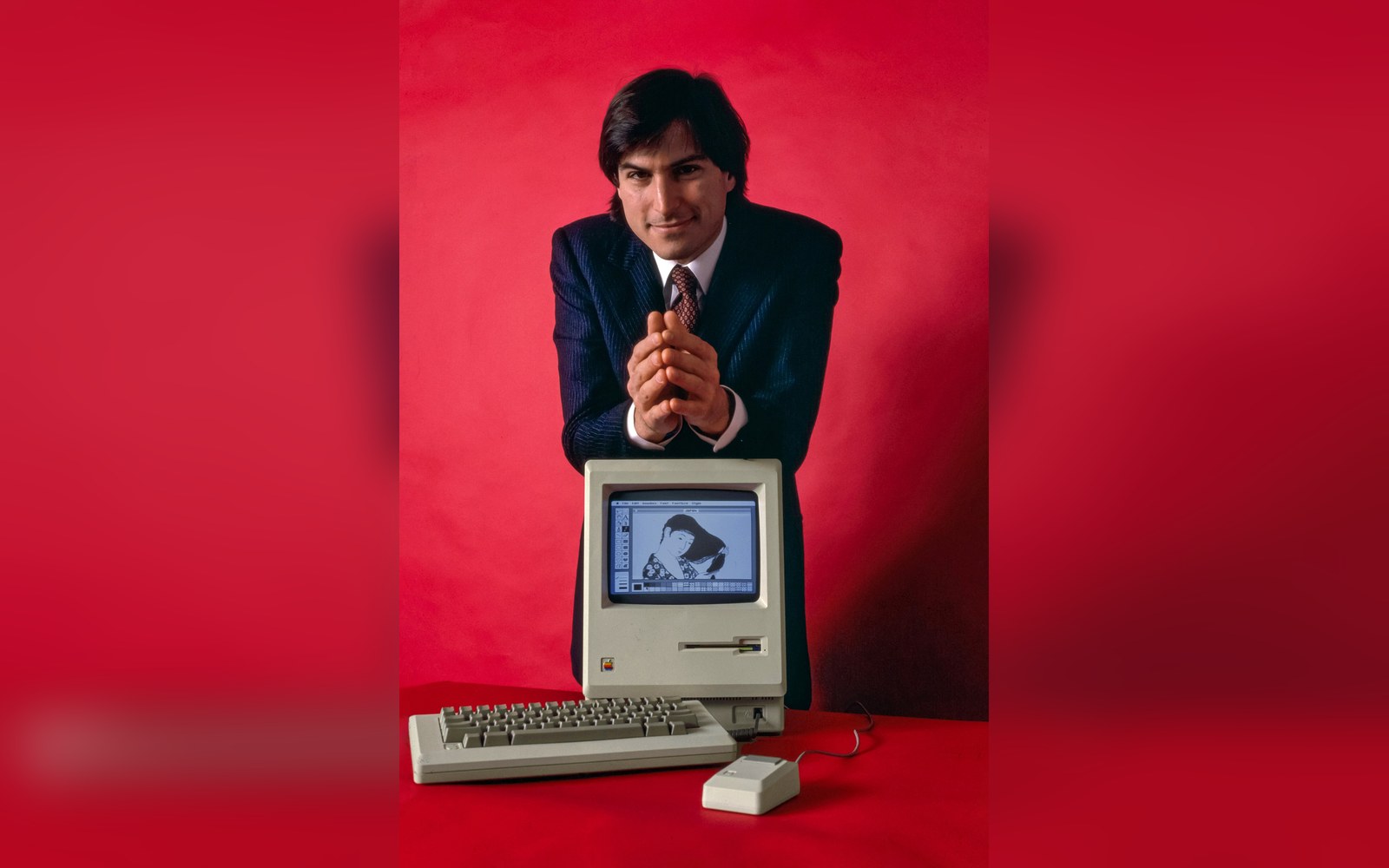
512 by 342 pixels, one bit deep: every icon on this screen had to survive being drawn on a 32-pixel square.
Photo: Steve Jobs and Macintosh computer, January 1984, by Bernard Gotfryd - edited · Wikimedia Commons
That gap — between a typeface existing and a typeface being available — became the premise for FontShop. In 1990, Brody co-founded FontShop International with Erik Spiekermann and Spiekermann's partner Joan Spiekermann in Berlin, establishing one of the first independent digital type distributors. The timing was precise: desktop publishing had restructured who could set type, but the retail infrastructure for digital fonts was thin, poorly organised, and largely tied to hardware manufacturers. FontShop sold faces by mail order and later online, aggregating type from many designers and foundries under a single catalogue. Its own label, FontFont, gave designers including Brody a commercial outlet for original work; his FF Blur and FF Pop appeared there in the early 1990s.
The two moments are connected. The Face demonstrated what custom typography could do to the register of a page. FontShop built the market logic that let type exist outside the institution — outside Linotype, outside Berthold, outside the foundry system — as a purchasable digital file. Brody moved from making the argument to distributing the means.